
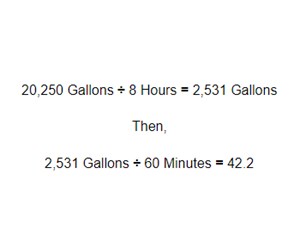
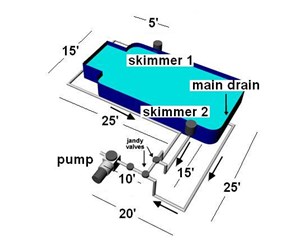
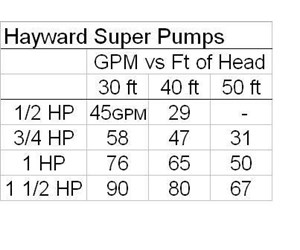
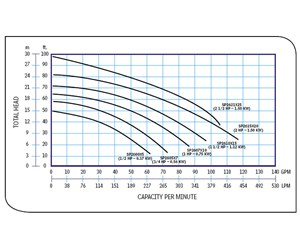
When purchasing a new in-ground swimming pool, you need to determine what size pool pump is required. There is a tendency to purchase a bigger pump than what is necessary because people think bigger is better. However, not only does this lead to higher operating costs, but you may also be overpowering your filter system. As a general rule, you should have a pump that filters all the water in a pool in an eight-hour period. This page will show you how to select a pump that filters all the water in your pool in eight hours.
Click Here to View Inground Pool Pumps



Mary Coleman Posted: 6/7/2022
I have a 20 x 40 30,000 gallon in ground pool, 1.5" plumbing, 1 HP Hayward pump, and 3.1 sq. ft sand filter. Is this sufficient or should I have a larger pump and filter?Reply
InyoPools Product Specialist Matt S. Posted: 6/9/2022
The equipment is already in the pool; you would be better able to tell me if the equipment is adequate for your pool. Is the water clear, does the water chemistry seem healthy, and are you happy with the operation of the equipment? With that basic information in the comment, I can say, "go with a bigger filter and pump," but I don't know if it is actually necessary.Reply
Rich Posted: 5/4/2022
I have a 20 x 40 36,000 gallon in ground pool, 1.5" plumbing, 1 HP Pentair pump, and 3.1 sq. ft., 62 gpm flow rate Hayward sand filter. Also a pool heater. Need to replace pump and filter with variable pump and cartridge filter. Pump is 6' from edge of pool, which has 2 skimmers and 2 returns, not sure how deep the pipes run. Straight line from pump to center drain is about 16 feet. From pump, it's about 18 ft to skimmer 1, 60 ft to skimmer 2, 30 ft to return 1 and 45 ft to return 2, going around corners (not straight line). What's the best pump/filter combo to move the most water with the existing plumbing? Thanks!Reply
InyoPools Product Specialist Matt S. Posted: 5/11/2022
What is the model number of your current pump? The information provided is excellent, but calculating feet of head blind is not a good way to do things. So, we'll use your current pump as a baseline. Also, "moving the most water" you can is not always the best way to do things.Reply
Cleveland Wardrick Posted: 4/11/2022
I have a 20k kidney shaped pool, 9' deep end 3' shallow end. My filter is a PLDE48 Mod 3. I estimated about 56 gpm in a 6 hour time and about 40 feet of head. With a clean filter running at about 10 psi.(2" piping) I was looking at getting the Jacuzzi 1.85 pump. Would this be to much or will that be sufficient? Thanks in Advance.Reply
InyoPools Product Specialist Matt S. Posted: 4/14/2022
We don't carry any Jacuzzi 1.85 VS pool pump, so I am not sure which model you reference. Jacuzzi is a manufacturer that sells different lines of VS pumps, which would have varying flow rates. But it looks like you have all the information needed to look at the pump curve for the specific model.Reply
Anonymous Posted: 4/9/2022
I have a 16,000 gallon pool under construction. Tristar VS 950 pump. Will a C100S filter be sufficient?Reply
InyoPools Product Specialist Matt S. Posted: 4/14/2022
Yes, it should be enough based on the information provided.Reply
Lawrence S Posted: 3/25/2022
I have a 40,000 gal inground pool, SD80 sand filter, 1HP pump, and 1.5 plumbing. I’m getting 50GPM flow measured coming out of the filter but my circulation and pressure is low on the 2 drains, 3 skimmers, and jets. Thinking about upgrading to 1.5 or 1.65 VS pump to increase circulation for my size pool but concerned about the plumbing size and if it would even help. But initially I was thinking the pump is undersized based on the size of my pool. Any thoughts? ThxReply
InyoPools Product Specialist Matt S. Posted: 3/28/2022
The 1HP pump is undersized for a 40,000-gallon pool, but the 1.5" plumbing restricts you from going higher than a 1.5-1.65HP. 2HP pump would cause cavitation, which is terrible for your system. The flowrate boost produced by switching to a 1.65VS pump should give you a noticeable difference.Reply
Anonymous Posted: 10/12/2021
Do you have formula calculations in metrics?Reply
InyoPools Product Specialist Matt S. Posted: 10/14/2021
No, but you can use an online gallon to liter calculator to use the formula, and then convert the totals back to metric.Reply
QDallas Posted: 10/4/2021
I have an 25K gallon pool. I believe I have 60 feet of head (It's a 13x40, with the pump being at the far catty corner from the farthest skimmer, so does 60 sound about right?) My filter is a cartridge filter than can handle 140 gpm. The pump that died is 1.5 hp, however it was driving a sand filter for most of it's life. According to my calcs is 1.4 or 1.65 the best size waterway pump to get?Reply
InyoPools Product Specialist Matt S. Posted: 10/5/2021
You've done some excellent work there. You are correct; the 1.65 would be my preferred choice. Of course, you could always go with a 1.65 or even a 2.7 HP VS to give you the top-end flow rate if you ever have to do a chemical treatment or heavy cleaning. But if you are going with a single speed, the 1.65 would be my choice.Reply
Brian jandy Posted: 8/14/2021
I have a inground pool 8 .000 gal heater getting a high limit fault have a3/4 hp about 45 feet from pool hot tub flow rate calls for 30 gpm I cleaned took cartridge filter out heater ran a little bit longer but still faulting so it's the heater or the pump I dont know do you think I need a 1 hp ??Reply
InyoPools Product Specialist Matt S. Posted: 8/17/2021
This sounds like a heater issue, not a pump issue. The hi-limit switch is telling the heater the water is too hot, not that there is a low flow. The most likely fix would be to replace the hi-limit sensor.Reply
PaulS Posted: 8/8/2021
I am wanting to replace my pool pump with a Hayward VS pump. My current pump is a 2HP motor, can I replace it with a TriStar VS 1.85HP or do I need the 2.7HP pump? The pool size is approximately 16,000 gallons. I am also thinking about replacing the 1HP pump for the water features but am not sure if it is worth buying a variable speed pump for the water features.Reply
InyoPools Product Specialist Matt S. Posted: 8/12/2021
What is the model number of your pump housing? There is a wide range of pool pumps, I would need to know what you have to accurately compare the two.Reply
Paul S Posted: 8/12/2021
If I am reading it correctly it is B855, part # 0-177897-22.Reply
InyoPools Product Specialist Matt S. Posted: 8/13/2021
That is the motor number. You need to look on the pump housing for the sticker, and not the motor case. You can see the difference between the two, here - Pool Parts 101: The Difference Between a Pump and a MotorReply
Paul S Posted: 8/13/2021
Unfortunately there are no tags on the pool case. Only on the motor itself.Reply
InyoPools Product Specialist Matt S. Posted: 8/17/2021
You should be able to use the TriStar 1.85 as a replacement for most pool pumps. The TriStar is Hayward's high-end residential pump, so it pushes more water than your standard Hayward Super II or Pentair WhisperFlo.Reply
Bernie Posted: 7/19/2021
I just replaced my Haywood Super pump that was a 2hp with a1.5hp. I have a small kidney shaped pool with 21,000 gallons. Free installation, my Haywood heat pump is showing a P5 error and will not go on. Any thoughts?Reply
InyoPools Product Specialist Matt S. Posted: 7/20/2021
Ok, you replaced a 2 HP pump with a smaller 1.5 HP; and now your heat pump is reading a PS code? If you reference the HeatPro manual it shows "PS" is referencing a low-pressure switch. I would take a look at the HeatPro Manual on page 18 for a list of solutions.Reply
Don Posted: 7/19/2021
I have a 26300 gal pool which is 55ft from the pump and filter using 1.5 pipe. I have calculated a 180 head. The pool was installed by the previous owner about 25 years ago with a 1HP Hayward, I replaced the pump with a 1 HP SuperFlo High performance Pentair. Could I up to a 1.5 Hayward?Reply
InyoPools Product Specialist Matt S. Posted: 7/23/2021
I think your calculation of feet of head is incorrect. A 1 HP pump would have trouble getting good flow through 90 feet of head, let alone 180 ft. You may be able to go up in HP, depending on the size of your filter. What is the model number of your filter?Reply
Lori Posted: 5/7/2021
What size pump do I need to run three 8ft. cascades? Using 2" pipe that reduces to 1.5" in three inlets on each 8ft. cascade. Anyone?Reply
InyoPools Product Specialist Matt S. Posted: 5/13/2021
If this is a new install, does the cascade waterfall manual list a required/optimal flow rate? If this is an old install and you are just replacing the pump, what is the model number of the old pump?Reply
Jennifer Posted: 5/4/2021
I have a 13'8" x 30' 12,000 gallon pool and our Jandy Model#PMPM,1.5 Serial#K07FC0389 went out after 12 years. We purchased a Hayward Super Pool Pump 115/230V 1.5 HP (suggested by a pool company) but it seems so much smaller. I just want to make sure it will work without overworking my pool before installing. Any advice you can share is greatly appreciated!Reply
InyoPools Product Specialist Matt S. Posted: 5/13/2021
The 1.5 HP Hayward Super Pump should be well suited for a pole that size. I'd go ahead and install.Reply
Jennifer Posted: 5/13/2021
We did and so far it is working great! Thanks for the feedback!Reply
Jonathan Posted: 3/24/2021
Hello, I have a 28,000 in-ground pool. if the pool originally had 2 pump motor can i change that to just one motor?Reply
InyoPools Product Specialist Matt S. Posted: 3/26/2021
What do you mean by a 2 pump motor? Do you mean the pool had two pumps? Regardless of the answer, I would need to know the pumps' make and model to get an idea of what might need to replace them. Does the pool have a spa, water features like laminar or deck jets, or does it have a solar heater?Reply
Heather Posted: 3/1/2021
The pool is small. 9000 gal. 5 1/2 ' deep. I have absolutely no idea how to calculate filter size for this. The motor is 1 1/2 hp. The present sand filter is quite old fiberglass and our current record freeze damaged it. It is 30" high that sits on a 6" high base and circumference is 6 1/2 '. It's a Triton (part #140210 (?)). It has a drain valve on the bottom. My search has not found a match for this. Can you help??Reply
InyoPools Product Specialist Matt S. Posted: 3/1/2021
What is the model number of your pump housing? Pump flow rates can vary widely depending on the pump model.Reply
Heather Posted: 3/3/2021
Pentair pump. Model # DYNII -1 - 1 1/2 Part # 340106 1.5 hp 230/115V 60Hz 1PH KW 3450 RPM MaxAmps 8.0/16.0 Again the damaged sand filter is a Pentair Triton II Part # 140210 fiber glass. 30" high on a 6" base. 6 1/2' circuReply
InyoPools Product Specialist Matt S. Posted: 3/4/2021
Is this an inground or above ground pool? Because the DYN is a Pentair Dynamo pump that is used mainly on above ground pools. I did a search for both of the model numbers you listed, and the models came up on our site: 140210 and 340106Reply
Heather Burk Posted: 3/5/2021
It's an in ground pool. 20x30. 9000 gal. 5 1/2 deep. Think it's suppose to be called a sports pool. (?)Reply
InyoPools Product Specialist Matt S. Posted: 3/8/2021
You can go with the same sized sand filter (140210), but if you are on a budget and you are sticking with the same pump, you can use a 21-inch tank Triton II TR50 Filter Side Mount 21 Inch Tank - 140249.Reply
Leonard Posted: 1/13/2021
I have a 200k Gallons in ground pool , what size pump would i need and also what filter would be suitable ? ThanksReply